2026年9月30日
The Vase That Sleeps in Zhongnanhai
How a landscape painted in cobalt found its way behind the most guarded walls in China.
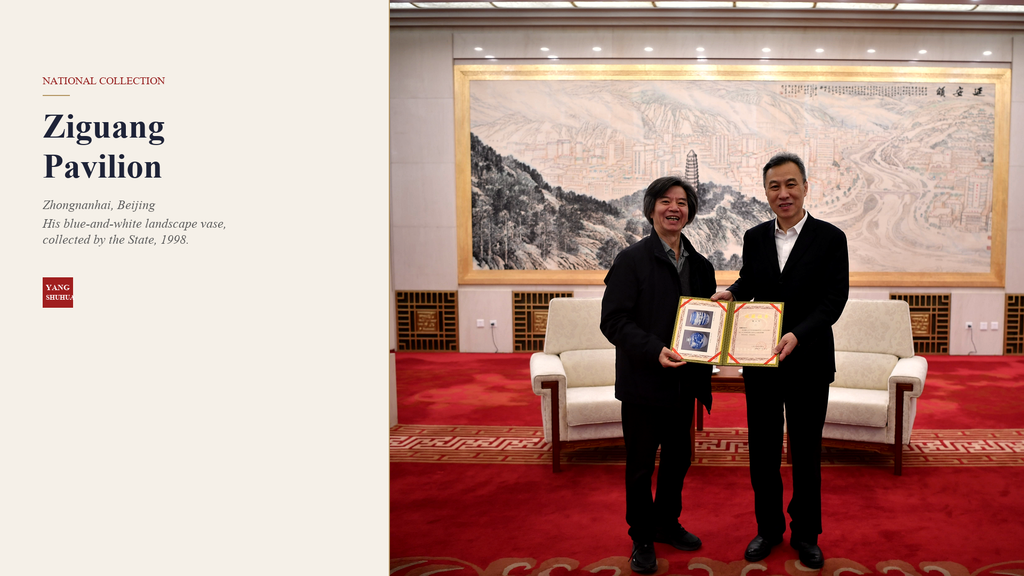
In Beijing, behind the vermilion walls of Zhongnanhai, stands Ziguang Pavilion — the Hall of Purple Light, where the State of China receives and honours its most distinguished guests. Few objects are ever placed there. Fewer still remain.
One of them is a vase.
It is not a palace treasure from the imperial kilns, nor a relic of a long-vanished dynasty. It was fired in our own time, in a small atelier in Jingdezhen, by the hand of one man. Its body carries a landscape in underglaze blue — mountains dissolving into mist, pavilions floating above water, the quiet grammar of Chinese literati painting translated into clay.
In 1998, the State of China chose this vase for its permanent collection. For nearly three decades it has stood in Ziguang Pavilion, seen by heads of state and honoured guests, its blue still breathing.
The man who painted it is Yang Shuhua.
A Master of the Second Generation
Yang Shuhua was born in 1954 in Jiangxi Province — the province that gave the world Jingdezhen, the porcelain capital that has burned for a thousand years. He studied fine art under Professors Hu Xianya and Li Linhong at the Jiangxi School of Arts, where the discipline was not ceramics but painting in the classical Chinese tradition: ink, brush, and the philosophy that a landscape is never a view, but a state of mind.
For over forty years, he has devoted himself to one pursuit: carrying the literati landscape into porcelain. Where a scholar-painter uses rice paper and ink, Yang Shuhua uses a porcelain body and cobalt. The brushwork is the same — the wet-on-wet washes, the dry-brush texture, the restraint of a single loaded stroke — but the canvas is born in fire and survives it.
In 2012, he was conferred the title of National Master of Arts and Crafts of China — one of the highest honours the country bestows on a craftsman, limited to a handful of living artists at any time.
Cobalt as Ink, Porcelain as Paper
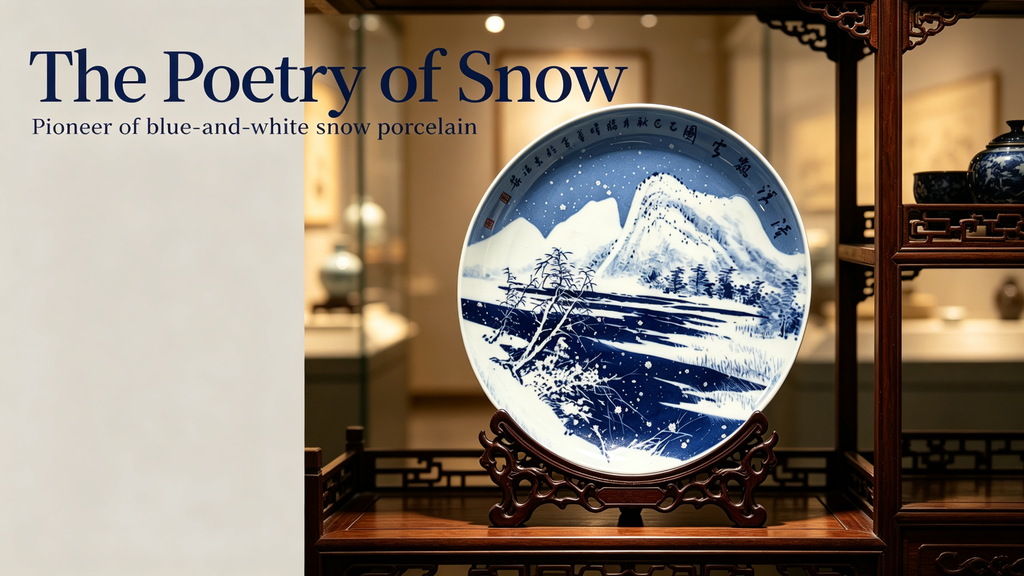
Yang Shuhua’s landscapes are recognisable at a glance: mountains rendered with the economy of an ink painter, mist left to the white of the clay, and — his signature — snow.
Snow in blue-and-white porcelain is almost unheard of in the traditional canon. White-on-white is a notoriously difficult game: one must draw snow with emptiness, letting the porcelain itself become the fallen snow, the pale sky, the frozen river. Yang Shuhua pioneered this genre of snow-scene porcelain ware, and it remains his most sought-after body of work. His principle, drawn from the great Tang painter Zhang Zao, is simple: “Wai shi zao hua, zhong de xin yuan” — learn from nature, find the source within.
Where His Work Rests
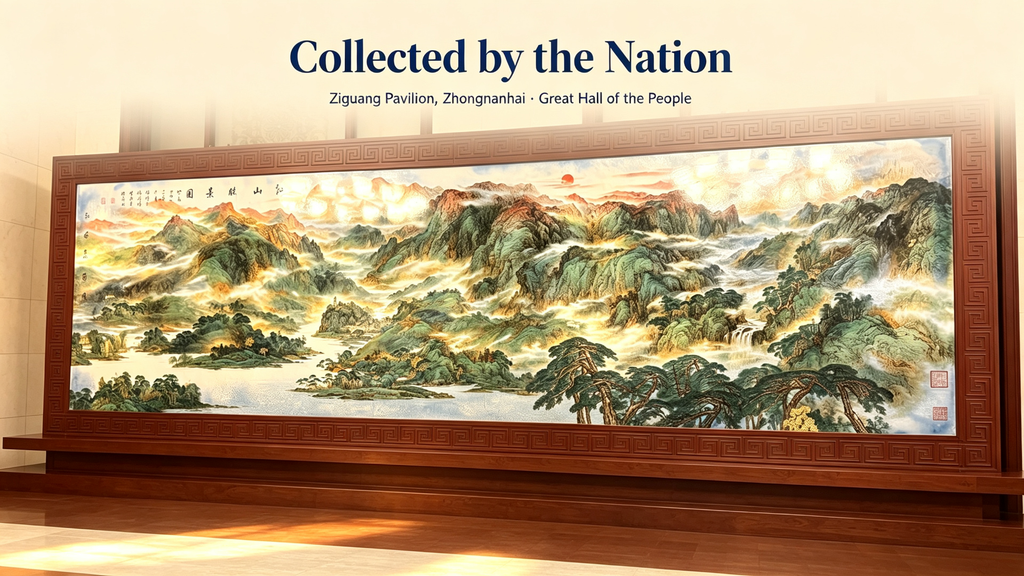
Beyond the vase in Ziguang Pavilion, Yang Shuhua’s work is held by the Great Hall of the People in Beijing, where his monumental landscape mural Jiangshan Shengjing Tu (The Prosperous Landscape of Rivers and Mountains) — created with three fellow masters — decorates the state guest hall. His pieces also sit in the China National Arts and Crafts Museum and have taken top awards at major national and international exhibitions.
Why Collectors Follow Him
For the collector, Yang Shuhua’s work offers three things that are increasingly rare in the porcelain market:
Provenance that cannot be fabricated. His pieces carry complete records: creation context, studio documentation, and, for the landmark works, the simple fact of national collections. When a State keeps one of your vases for three decades, the market listens.
A genre he invented. The snow-scene landscape ware is his alone. A collector who wants the pioneer of a form must come to Yang Shuhua — there is no other source.
The quiet end of the spectrum. His work does not shout. It rewards patience: the mist that only appears at a certain angle of light, the brushstroke hidden inside a mountain. That is the aesthetic of the literati tradition — and it has held value for a thousand years.
Today, every piece released from Yang Shuhua’s atelier is accompanied by its full provenance record. The mountains he paints have been the same mountains for forty years — and each one is painted fresh, by hand, in fire.
The vase in Ziguang Pavilion does not travel. But the work continues to leave Jingdezhen, one piece at a time, into the collections of those who understand what it means to hold a landscape in your hands.
— Yang Shuhua Atelier, Jingdezhen