2026年10月1日
How a Snow Landscape Is Born in a Kiln
What it takes to paint winter on a piece of porcelain — and why the snow almost never comes out.
In Jingdezhen, the porcelain capital of China, a kiln fires at around 1,300 degrees Celsius. Inside it, cobalt turns from grey to deep blue, glass glaze runs and seals, and clay that was soft as dough becomes hard as stone. Nothing inside that kiln can be changed afterwards. What leaves the fire is final — permanent — exactly as it went in.
This is the gamble at the heart of every blue-and-white piece. But some gambles are bigger than others. Painting a snow landscape on porcelain is one of the biggest.
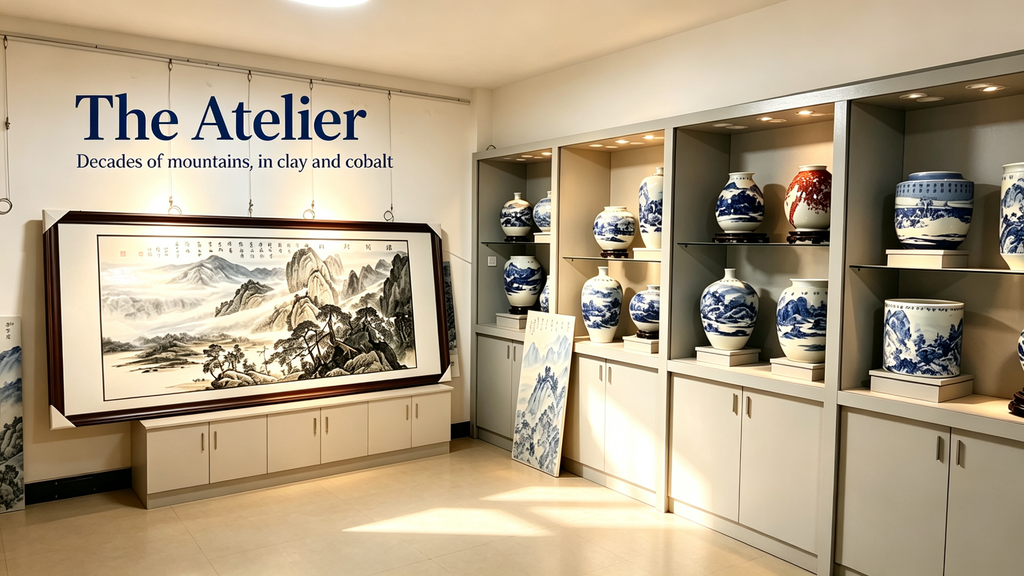
A genre no one else was playing
Yang Shuhua did not set out to invent a genre. For forty years he painted the classical literati landscape — misty mountains, pavilions, rivers — the tradition he studied under Professors Hu Xianya and Li Linhong. But one winter, watching snow settle on the hills outside Jingdezhen, he asked the question that would define his career:
Can snow itself be painted — in blue and white?
In traditional blue-and-white porcelain, snow is almost never attempted. There is a reason. Cobalt is a dark blue pigment; there is no white pigment you can add. The only white in the piece is the porcelain body itself, and it appears wherever the painter simply does not paint. To draw snow, then, you must draw everything around it — and trust the empty space to become the snow.
A single brushstroke that cannot be corrected
The process begins with a plain porcelain body, shaped on the wheel and dried until it is hard but still porous — the way clay must be to drink in pigment.
Yang Shuhua works in underglaze blue. He mixes cobalt oxide to different dilutions, then applies it directly onto the raw, unfired clay. One wash of light cobalt for distant mountains. A heavier, darker brew for the rocks in the foreground. The brushwork is the same wet-on-wet technique as ink painting on paper — except that paper forgives, and porcelain does not.
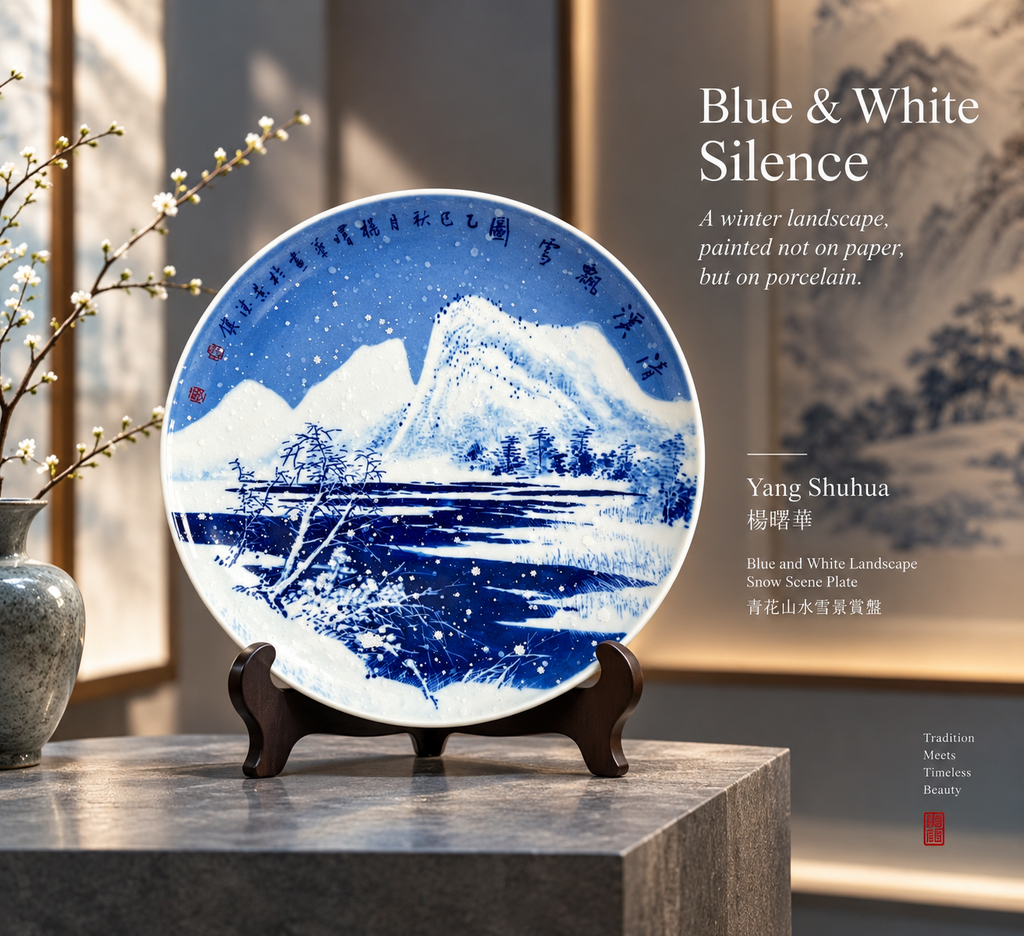
The snow, he leaves. It is the untouched porcelain itself: the blank peaks, the pale sky, the frozen river running down the middle of the scene. The composition is judged by what is not drawn — one stroke too much, and the snow becomes mud; one stroke too little, and the mountain loses its bones.
Then comes the glaze, a thin coating of glass that will seal the cobalt under it, and then the kiln.
The kiln keeps no promises
The firing takes hours, and the temperature must rise and fall by exact discipline. If the kiln atmosphere drifts, the cobalt grey-blue can turn too dark, or the glaze can crawl and leave a bare patch on the shoulder of the vase. There is no retouching, no second chance. A single piece can spend a week being painted and one wrong hour being lost.
This is why genuine snow-scene ware is rare — not because the image is complicated, but because the margin for error is almost invisible. In an age of machine-made porcelain and printed transfers, the proof of a hand-painted piece is always the same: no two are alike. The mountains carry the same shapes, never the same life.
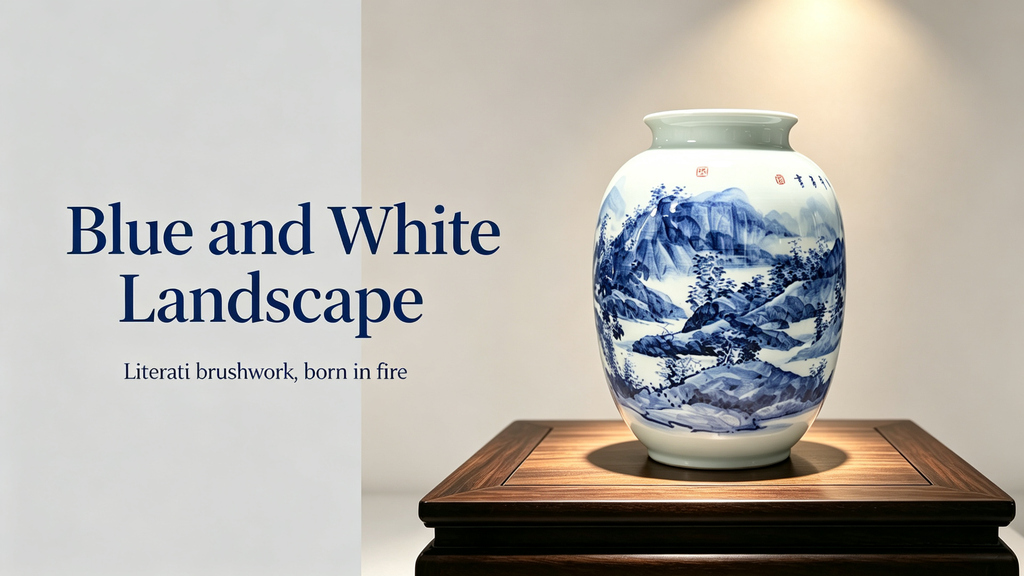
What collectors are really buying
When a collector holds a Yang Shuhua snow landscape, what they are holding is a controlled accident — hours of brushwork, a week of waiting, and one moment in the kiln where everything went right. The piece in front of them is the survivor. Its companion, fired in the same hour, may never have left the ground.
His guiding principle, from the great Tang painter Zhang Zao: “Wai shi zao hua, zhong de xin yuan” — learn from nature, find the source within. He has painted the same mountains for four decades, and each time the snow is different.
In Jingdezhen, a thousand-year-old city built on a thousand-year-old fire, the rarest thing is not the ancient ware in the museums. It is a new piece that carries the old discipline — and survives.
— Yang Shuhua Atelier, Jingdezhen